

- August 4, 2026
- Admin
- 0
Business Challenge
Building the subscriber-management layer for a new municipal broadband service
A municipal gas and electric utility launched a fibre-to-the-home initiative to provide high-speed Internet services to residential and business customers across its service territory.
To support the new broadband offering, the utility required carrier-grade Broadband Network Gateway infrastructure capable of dynamic subscriber provisioning, per-subscriber quality-of-service enforcement, and high availability.
The existing core network was built on HP 5800 series routers with dual upstream ISP links, but it lacked the subscriber-management layer required to deliver differentiated broadband services.
The design needed to support residential subscribers using dynamic IP addressing and business subscribers using static IP addressing, multiple service tiers at 200 Mbps and 1 Gbps, non-stop service delivery without a single point of failure, and centralized QoS and security-policy enforcement.
Legacy Core Without Subscriber Intelligence
The existing network did not provide the subscriber-management capabilities needed for the new residential and business services.
Multiple Broadband Service Profiles
The architecture had to support 200 Mbps residential, 1 Gbps residential, and 1 Gbps business service profiles.
Carrier-Grade Availability
Redundancy was required across access, gateway, synchronization, core-uplink, and upstream connectivity.
Centralized Subscriber Policies
Per-subscriber QoS and security policies had to be enforced centrally at the BNG layer.
Solution Overview
Dual redundant BNGs with Enhanced Subscriber Management
The design introduced a dedicated subscriber edge while retaining the utility’s existing access and core-routing environment.
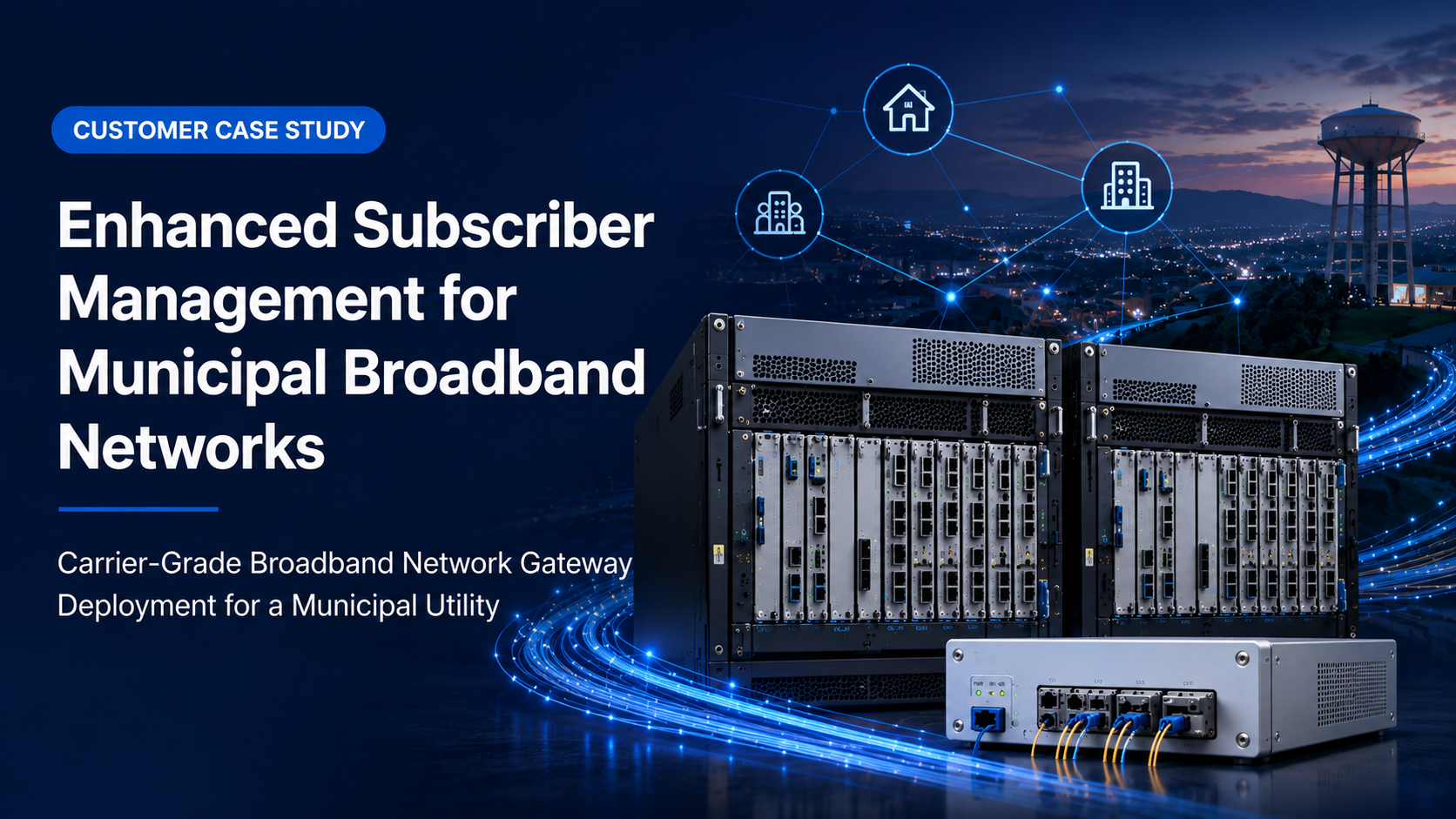
A pair of 7750 SR-7 Service Routers was deployed as redundant Broadband Network Gateways and integrated with 7360 ISAM FX fibre access nodes and the existing core-routing infrastructure.
Enhanced Subscriber Management enabled fully dynamic, DHCP-triggered subscriber provisioning within a Virtual Private Routed Network service context.
Key Design Elements
Dual-Homed Access Nodes
Each fibre access node connects to both BNG routers over 10 Gbps links, ensuring that no single link or node failure disrupts subscriber services.
Subscriber Router Redundancy Protocol
SRRP provides active/backup gateway redundancy for all IPoE subscribers. If the master BNG fails, the backup assumes the master role and takes ownership of subscriber default gateways.
Multi-Chassis Synchronization
MCS mirrors subscriber state; including IP and MAC mappings, QoS profiles, and DHCP lease data between the two BNGs in real time over a dedicated TCP connection.
Routed Central Office Model
Subscriber interfaces, group interfaces, and dynamically created Managed SAPs are triggered by DHCP Discover packets, eliminating manual per-subscriber SAP provisioning.
Internal DHCP Servers
Each BNG operates a local DHCP server for IP address assignment, synchronized through MCS and supporting normal, communications-interrupted, and partner-down operating modes.
Architecture Highlights
A redundant subscriber edge integrated with the existing access and core network
The architecture combines redundant BNG platforms, dual-homed fibre access, synchronized subscriber state, dynamic provisioning, routed uplinks, and diverse upstream connectivity.
Quality of Service
Centralized per-subscriber policy enforcement
QoS enforcement is centralized at the BNG layer, with three service profiles mapped to the utility’s residential and business offerings.
Downstream traffic toward subscribers uses per-subscriber shapers to guarantee contracted bandwidth.
MCS synchronizes QoS state across both BNGs so that policy enforcement continues during failover events.
Residential — Dynamic IP
Best Effort forwarding class for the 200 Mbps residential service tier.
Residential — Dynamic IP
Best Effort forwarding class for the 1 Gbps residential service tier.
Business — Static IP
Low Priority 2 forwarding class for differentiated treatment of business subscriber traffic.
Per-subscriber shaping and synchronized QoS state allow contracted service policies to remain enforced across the redundant BNG pair.
Resiliency and Failover
Coordinated recovery across access, gateway, synchronization, and routing layers
The architecture was validated against multiple failure scenarios to support non-stop service delivery.
SRRP coordinates subscriber gateway ownership between the active and backup BNGs, while MCS maintains synchronized subscriber, DHCP, and QoS state.
OSPF convergence and the redundant inter-BNG and core links provide alternate forwarding paths when access or uplink failures occur.
BNG-to-Core Uplink Failure
Traffic reroutes through the inter-BNG link aggregation and uses the peer BNG’s core uplink.
Access Node-to-BNG Link Failure
SRRP triggers failover to the surviving BNG path connected to the dual-homed access node.
Inter-BNG Link Failure
Each BNG continues to operate independently through its direct connection to the core network.
Combined Access and Uplink Failure
Traffic converges on the fully connected BNG through automatic SRRP and OSPF reconvergence.
Business Outcomes
A scalable and resilient foundation for municipal broadband services
Redundant Broadband Infrastructure
The deployment established a fully redundant, carrier-grade platform for residential and business Internet services delivered over fibre.
Differentiated Subscriber Services
The BNG design supports distinct residential and business profiles, including dynamic and static IP addressing and differentiated service tiers.
Dynamic Provisioning
Enhanced Subscriber Management eliminated manual per-subscriber configuration through DHCP-triggered provisioning and dynamically created Managed SAPs.
Non-Stop Service Design
Dual-BNG redundancy, SRRP, MCS, dual-homed access, and routed failover mechanisms support continued service through multiple failure scenarios.
Subscriber and Network Isolation
The VPRN-based architecture provides separation between subscriber traffic and network operations.
Foundation for Service Expansion
The architecture establishes a scalable foundation for future service expansion, including voice and video offerings.
Conclusion
Carrier-grade subscriber management integrated into the municipal utility network
The deployment introduced a redundant Broadband Network Gateway layer built on 7750 SR-7 Service Routers, with Enhanced Subscriber Management, SRRP, MCS, dynamic DHCP-triggered provisioning, centralized QoS enforcement, and coordinated routing failover. The resulting architecture enables differentiated residential and business broadband services while maintaining subscriber-state synchronization, service resiliency, and separation between subscriber traffic and network operations.
Discuss your broadband and subscriber-edge requirements with Telence Solutions
Connect with our engineering team to discuss resilient BNG, subscriber-management, access, routing, and service-delivery architecture.
Contact Our Team