

- July 3, 2026
- Maneesh Gupta
- 0
Business Challenge
Utility-controlled connectivity across a dispersed grid environment
The utility needed a private wireless network connecting substations, switching stations, and field devices throughout its transmission and distribution territory.
Commercial cellular networks could not provide the required combination of reliability, latency, and operational control for grid communications. Shared public infrastructure also complicated the management, security, and audit requirements associated with communications systems connected to the Bulk Electric System.
The network had to support dedicated coverage around utility substations and field sites rather than population centres, deterministic and low-latency transport for protection and SCADA traffic, and unattended environments where hardware failures must be detected and recovered from automatically.
The utility required dedicated licensed spectrum, control over coverage planning, and independence from third-party carrier decisions rather than a managed service operating on shared commercial infrastructure.
Solution Overview
A standards-based Private LTE architecture with redundant DMVPN transport
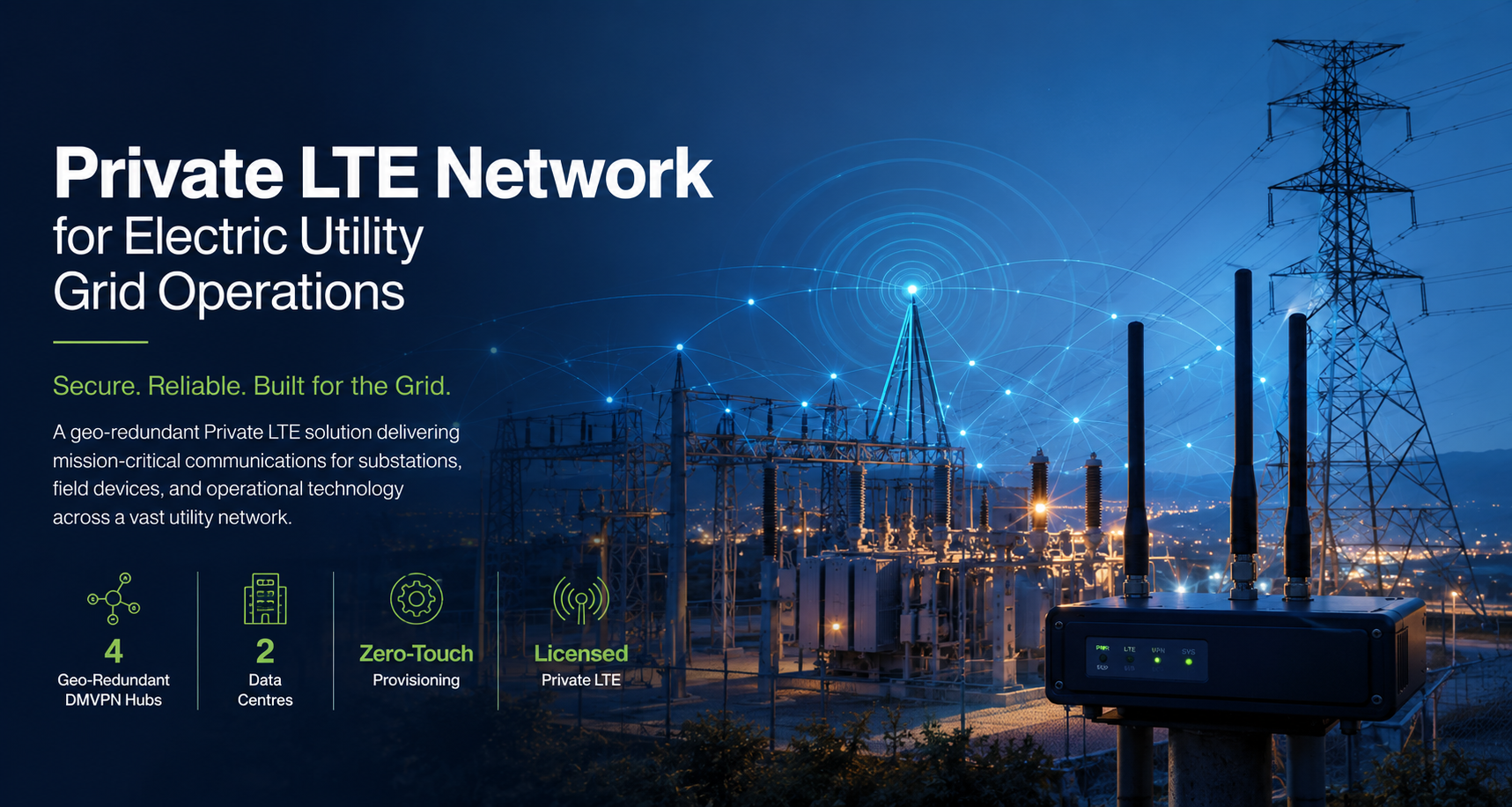
Telence Solutions designed the network around geo-redundant data-centre headends, substation aggregation, ruggedized field user equipment, dedicated radio access infrastructure, and centralized management.
Four DMVPN headends
Four headend routers were divided between two geographically separate data centres, with each field router maintaining simultaneous tunnels to all four hubs for N+3 path redundancy.
Substation aggregation
Substation aggregation provides Layer 3 connectivity for the LTE base station and advertises substation and device subnets through dynamic routing.
Zero-touch field provisioning
New field routers automatically establish LTE connectivity, register with the headend network, and join the routing topology without on-site configuration.
Geo-redundant failover
The headend and core architecture supports automatic failover between data centres so grid communications can survive a router, link, or facility-level outage.
Industrial field hardware
Ruggedized field routers are rated for extreme temperature, vibration, and humidity, with pluggable cellular modules providing a future upgrade path to 5G.
Remote-site extension
Point-to-multipoint wireless backhaul extends network reach to remote substations and recloser locations where fibre is unavailable, with dedicated management addressing for visibility.
Architecture
Redundancy from the data-centre headends to the field edge
The architecture separates headend, transport, substation aggregation, field routing, operational technology connectivity, and management functions while maintaining dynamic routed connectivity across the network.
(N+3 path redundancy)
Simplified view of the functional relationship between the geo-redundant DMVPN headends, Private LTE transport and radio access network, substation aggregation, field routers, and connected operational technology devices.
Grid Communications Applications
One private network supporting field and substation operations
The network was purpose-designed for the utility’s operational technology environment, carrying prioritized communications between field locations and control-centre applications.
Third-party leased-line interconnection
Sites outside the private network footprint can interconnect through third-party leased-line circuits. Traffic crossing external networks is protected through encryption so the same security posture can be applied regardless of the underlying transport path.
Substation IED and protection communications
Field routers connect substation IEDs and protection-related systems to applications across the private network.
Distribution SCADA
SCADA traffic is carried with consistent prioritization to support real-time monitoring and grid control.
Recloser control and remote switching
Prioritized communications support recloser control and remote switching operations throughout the distribution environment.
Mobile workforce connectivity
Field users receive data connectivity for operational work, scheduling, and GIS applications.
Point-to-multipoint remote-site extension
Wireless links extend connectivity to remote substation and recloser locations where fibre deployment is impractical.
Field scheduling and GIS applications
Mobile workforce connectivity supports access to field scheduling and geographic information system applications.
Results and Benefits
Operational capabilities created by the Private LTE design
Grid Reliability
The dedicated, redundant Private LTE network delivers consistent, low-latency connectivity for protection and SCADA traffic that commercial networks cannot guarantee, supporting real-time grid monitoring and control.
Service Convergence
One private wireless network carries substation IED, SCADA, recloser control, and mobile workforce traffic in place of a patchwork of legacy point-to-point and serial links.
Zero-Touch Deployment
Zero-touch provisioning supports rapid field-router deployment at new substation and recloser sites without on-site engineering configuration.
Geo-Resilience
Geo-redundant headend infrastructure across two data centres, combined with N+3 path redundancy at every field site, helps ensure grid communications survive equipment, link, or facility-level outages.
Spectrum Independence
Private LTE operating on dedicated licensed spectrum gives the utility control over capacity, coverage, and prioritization independent of third-party carrier decisions.
Future-Ready Field Hardware
Industrial field routers with swappable cellular modules provide a future path to 5G without requiring replacement of the field-router platform.
Conclusion
A purpose-built wireless backbone for utility grid operations
This Private LTE deployment gave the utility a purpose-built, fully owned wireless backbone for grid operations, delivering the reliability and redundancy of a wired network over Private LTE transport. The architecture supports NERC CIP compliance requirements and provides a clear upgrade path to 5G as field requirements evolve.
Explore how Telence Solutions can support resilient grid communications
Discuss your utility communications or network infrastructure requirements with the Telence Solutions team.
Contact Our Team